
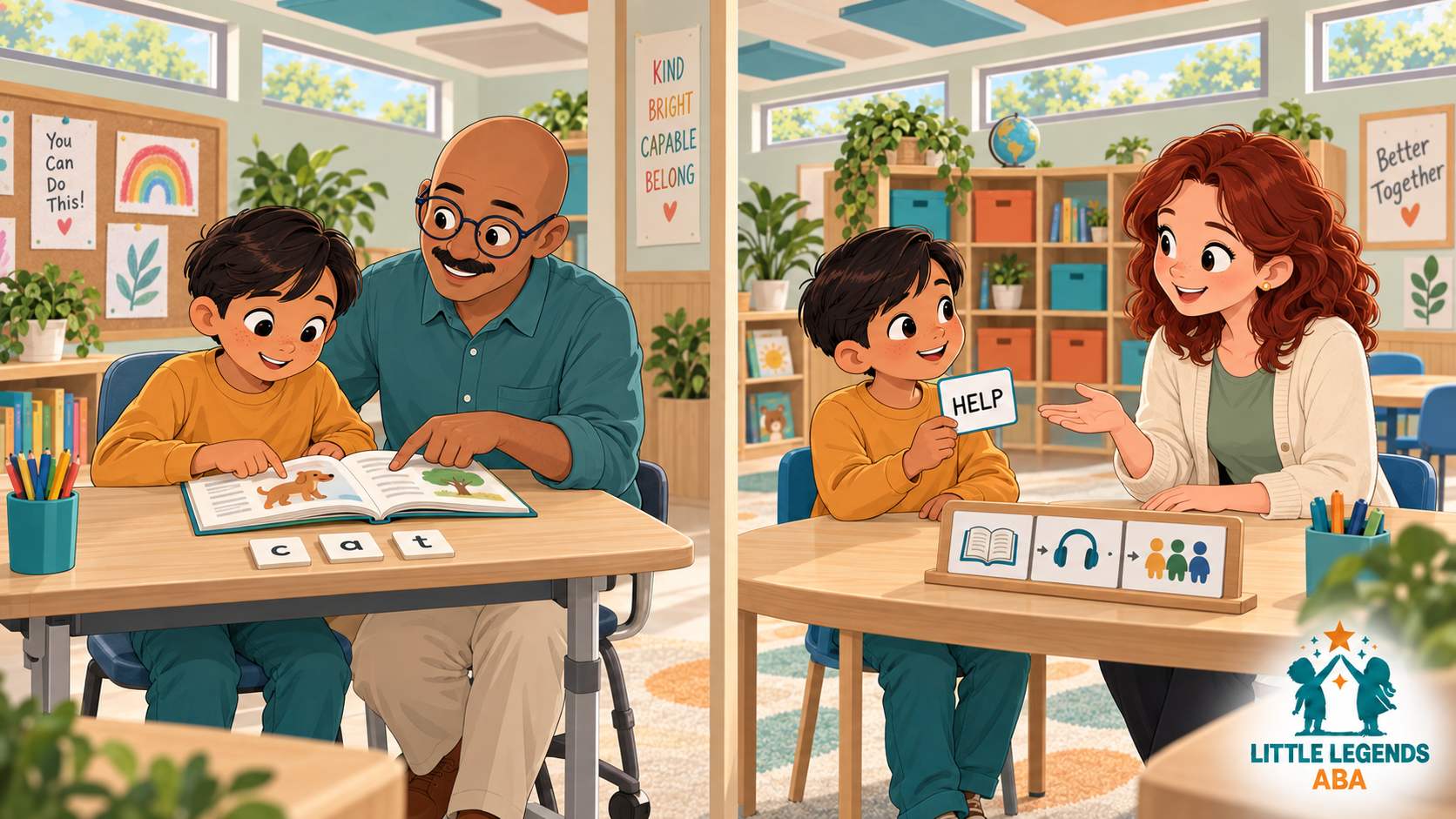
If you’re trying to understand school-based ABA vs special education, it can feel like you’re sorting through a lot of acronyms at once. Both can support children with autism spectrum disorder (ASD), but they do different jobs. Special education focuses on helping your child access learning at school, while Applied Behavior Analysis (ABA) focuses on understanding behavior and teaching practical skills through individualized support.
- Special education is an educational service, usually provided through an Individualized Education Program (IEP).
- ABA is a behavioral therapy approach that can support communication, daily routines, social skills, and behavior.
- School-based ABA may be included in an IEP when behavior affects a child’s ability to learn or participate at school.
- Parents have rights under IDEA, including the right to request evaluations, participate in IEP meetings, and ask for behavioral supports.
- Private ABA and school services can work together, but families may need to coordinate goals, schedules, funding, and communication.
What Is Special Education?

Special education is support provided through the school system for students with disabilities who need help accessing education. For many children, navigating the differences between an IEP and a 504 plan is the first step toward securing the right classroom accommodations.
An IEP may include:
- Academic goals
- Speech or occupational therapy
- Classroom accommodations
- Behavior supports
- Specialized instruction
- Progress monitoring
The main focus is school access. In simple terms, special education asks, “What does this child need in order to learn and participate in school?”
What Is ABA?
Applied Behavior Analysis (ABA) is a therapy approach that looks at how behavior works and how skills can be taught in small, meaningful steps. Research has examined ABA-based interventions for children with autism, including behavioral teaching methods and comprehensive programs, as discussed in this PMC review.
ABA may focus on skills such as:
- Requesting help or asking for a break
- Following routines
- Reducing unsafe or disruptive behaviors
- Building play and social skills
- Increasing independence with daily tasks
A Board Certified Behavior Analyst usually designs the plan, while a Registered Behavior Technician may provide direct support under supervision. Understanding the distinct roles of a BCBA and an RBT helps parents know who manages clinical decisions during therapy.
Some studies, including this PubMed abstract, have compared intensive behavior analytic services with other intervention models, though every child’s needs and response to support can be different.
The Main Difference: Learning Support vs Behavioral Support
The simplest way to compare them is this:
| Support Type | Main Focus | Common Setting |
|---|---|---|
| Special education | Accessing academic curriculum and school participation | Public or private school |
| ABA | Teaching skills and addressing behavior patterns | Home, clinic, community, or school |
This does not mean one replaces the other. A child may need both. For example, a student may receive reading support through special education while also needing ABA strategies to help with transitions, communication, or classroom behavior.
If behavior concerns are showing up as meltdowns, refusals, or shutdowns, it may also help to understand the meltdown vs tantrum difference, since the right response depends on what is really happening.
Can ABA Goals Be Added to an IEP?
Under the Individuals with Disabilities Education Act, school teams must consider the supports a child needs to receive a free appropriate public education, which often starts by requesting a special education evaluation to document specific learning needs.
A helpful process is:
- Request a meeting in writing. Ask to discuss behavior, learning access, and needed supports.
- Bring data. This may include behavior logs, private ABA reports, teacher notes, or evaluation results.
- Ask for clear goals. Goals should describe the skill your child is learning, not just the behavior adults want to stop.
- Discuss supports. This may include a behavior intervention plan, staff training, classroom strategies, or school-based ABA support.
- Clarify communication. Ask how school staff and private providers can share updates, with your written consent.
If you are waiting for services outside of school, this guide to the ABA therapy waitlist may help you think through next steps while you continue school planning.
What If the School and Private ABA Provider Disagree?
This can happen, and it does not mean anyone is failing your child. Schools and private providers may use different methods, collect different data, or focus on different settings.
It can help to ask:
- What behavior or skill are we trying to support?
- Is this goal needed for school access, home life, or both?
- What data is each team using?
- Can the BCBA attend an IEP meeting with parent permission?
- Can everyone agree on one or two shared strategies?
Try to keep the conversation centered on your child’s daily experience. A strategy that works beautifully in a clinic may need adjusting for a busy classroom.
Financial and Insurance Considerations
Special education services in public school are provided through the school system when included in the IEP. Private ABA is usually handled separately through insurance, Medicaid, waiver programs, or private pay, depending on eligibility and location.
Families in North Carolina may want to learn more about what the NC Innovations Waiver may cover. Funding rules can be detailed, so it is wise to ask your insurance plan, school team, and therapy provider what is covered before building a schedule around both services.
How to Decide Which Support Your Child Needs
A good decision starts with the setting where your child is struggling most.
Consider school-based support if your child:
- Cannot access instruction because of behavior or communication needs
- Needs help participating safely in classroom routines
- Has behaviors that interfere with learning during the school day
Consider clinic-based or home-based ABA if your child:
- Needs support with daily routines outside school
- Is working on communication, play, safety, or independence skills
- Needs more intensive one-on-one behavioral support
Many children benefit from both, especially when providers communicate clearly. The goal is not to collect services. The goal is to build a plan that fits your child’s real life.
Final Thoughts
School-based ABA and special education can both play important roles, but they are not the same thing. Special education helps your child access learning. ABA helps teach skills and address behavior in a structured, individualized way.
If you are unsure what to request, start with your child’s biggest barriers at school and at home. Then ask the IEP team, your BCBA, or another qualified professional what support would best match those needs. A coordinated plan can make the path feel much clearer for both you and your child.
References
- NIH: Meta-analysis of Early Intensive Behavioral Intervention for children with autism
- ResearchGate: Pyramid Model for Early Childhood Education
- NIH: A meta-analytic study on the effectiveness of comprehensive ABA-based early intervention programs for children with autism spectrum disorders
- NIH: Behavioral treatment and normal educational and intellectual functioning in young autistic children