
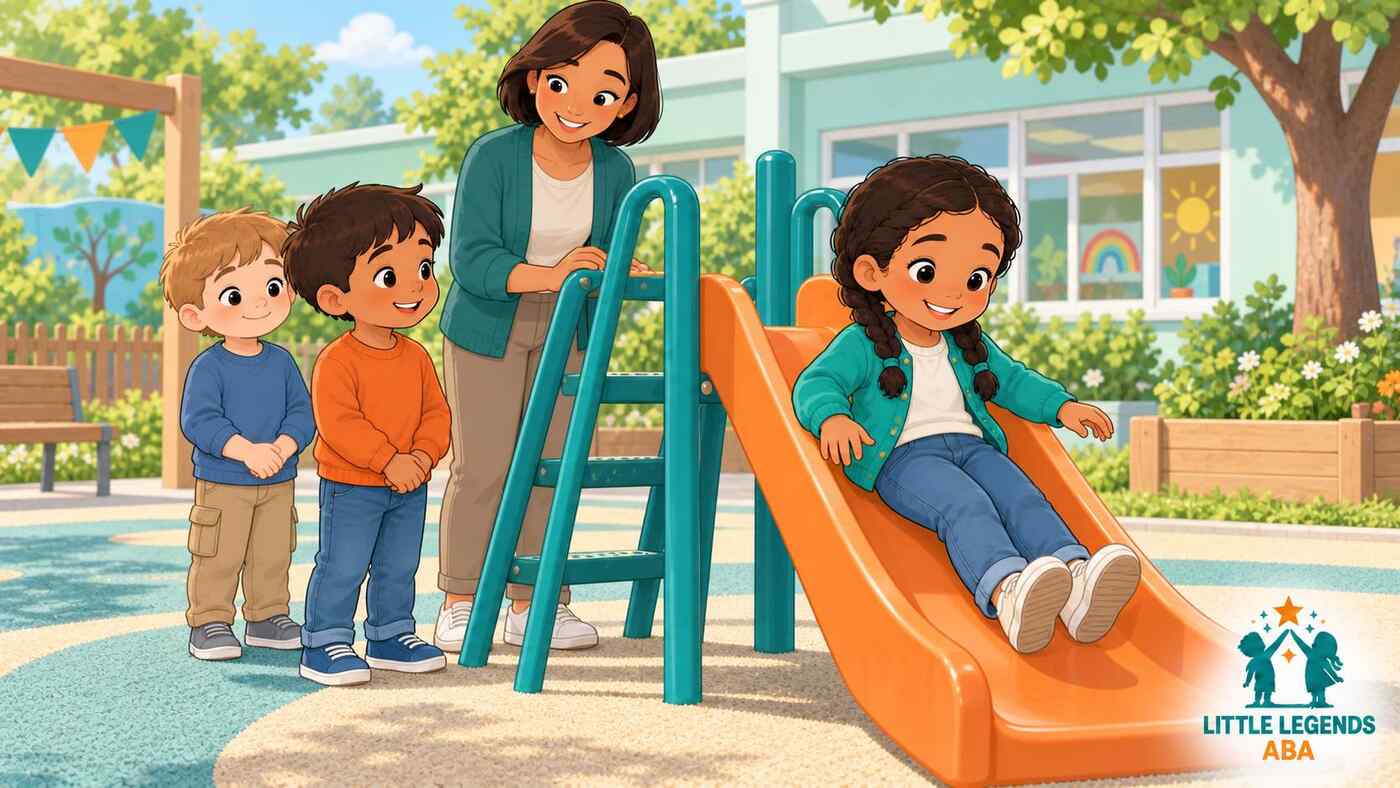
If your child receives ABA support at school, you may wonder what the team is actually working on during the school day. School-based ABA often targets behaviors that affect learning, safety, communication, independence, and social participation. The goal is not to make a child “perfectly compliant,” but to help them access the classroom with more confidence and less frustration.
Families who are also looking at services outside of school may find it helpful to learn how to find an ABA provider who can coordinate with school teams when appropriate.
- School-based ABA targets behaviors that interfere with learning, safety, communication, and classroom participation.
- Board Certified Behavior Analysts (BCBAs) often work with teachers, school staff, and IEP teams to connect behavior goals to school needs.
- Functional Behavior Assessments (FBAs) help explain why a behavior may be happening, which then guides Behavior Intervention Plan (BIP) goals.
- Common targets include task refusal, elopement, peer interaction, transitions, emotional regulation, and executive functioning skills.
- School strategies may look different from clinic-based ABA because the classroom has group routines, academic demands, and natural peer interactions.
How ABA Fits Into the School Team

In school, ABA is usually part of a larger support system. A Board Certified Behavior Analyst (BCBA) may help assess behavior, design supports, train staff, and review progress. Registered Behavior Technicians (RBTs), teachers, paraprofessionals, counselors, speech-language pathologists, and occupational therapists may also be involved.
Research on autism interventions and behavior support emphasizes matching strategies to the child’s needs and setting, including school routines and learning demands, as described in this PubMed review. Function-based support is especially important because the same behavior can have different reasons behind it, a point discussed in this behavior assessment article.
For families comparing supports, it can also help to understand how ABA overlaps with communication services like speech therapy.
Common Behaviors School-Based ABA Targets
School-based ABA targets can be grouped by the type of skill the child needs help building.
| Target Area | What It May Look Like at School |
|---|---|
| Classroom readiness | Sitting for short lessons, following routines, responding to directions |
| Academic engagement | Starting work, staying with a task, asking for help |
| Communication | Requesting breaks, saying no appropriately, using a device or visual support |
| Social interaction | Taking turns, joining play, responding to peers |
| Safety | Staying with the group, walking in line, reducing elopement |
| Self-regulation | Coping with changes, using calming strategies, tolerating waiting |
| Executive functioning | Organizing materials, planning steps, tracking assignments |
For younger children, goals may start with simple classroom participation, such as coming to circle time or using a visual schedule. As children get older, targets often shift toward independence, problem-solving, flexible thinking, and managing longer assignments.
From FBA Findings to BIP Goals
A Functional Behavior Assessment, or FBA, looks at what happens before and after a behavior. This helps the team understand the behavior’s possible function, such as escaping a hard task, getting attention, accessing an item, or responding to sensory discomfort.
Those findings should turn into clear Behavior Intervention Plan, or BIP, goals. For example:
- If task refusal happens during writing, the BIP may include shorter writing chunks, a choice of pencil or keyboard, and teaching the child to request help.
- If elopement happens during noisy transitions, the BIP may include a transition warning, a safe walking routine, and reinforcement for staying with the group.
- If a child struggles after poor sleep, the team may need to consider how sleep challenges affect attention and regulation during the school day.
Clinical ABA vs Classroom-Based ABA
The same goal can look different depending on the setting.
| Goal | Clinic-Based ABA | School-Based ABA |
|---|---|---|
| Following directions | Practiced in structured trials, sometimes using Discrete Trial Training (DTT) | Practiced during real classroom routines |
| Requesting a break | Taught with planned prompts and reinforcement | Used during academic work, transitions, or group lessons |
| Peer interaction | Practiced through arranged play or role-play | Supported during recess, lunch, centers, or group projects |
| Task completion | Built through structured teaching sessions | Adapted to classroom assignments and IEP goals |
Neither setting is automatically better. They simply serve different purposes. The best support often happens when providers communicate and keep goals consistent across home, clinic, and school.
Helpful Strategies for Task Refusal and Elopement
For task refusal, school teams may use:
- Clear first-then language.
- Smaller task steps.
- Choice-making.
- Positive reinforcement for starting work.
- Break requests taught before frustration builds.
For elopement, teams may use:
- Visual boundaries.
- Transition warnings.
- Adult positioning for safety.
- Reinforcement for staying with the group.
- Teaching the child where to go when they need help.
If services or funding are part of your planning, families in North Carolina may want to review what the NC Innovations Waiver may cover.
Conclusion
School-based ABA works best when goals are practical, measurable, and connected to your child’s real school day. If you are reviewing an IEP, ask how the FBA findings connect to the BIP, how progress will be measured, and how the team will support skills across settings. Every child’s needs are different, and a coordinated team can help make school feel more predictable, safe, and supportive.
References
- PubMed: Self-management interventions for reducing challenging behaviors among school-age students: A systematic review
- PubMed: Using a Nonconcurrent Multiple-Baseline Across-Participants Design to Examine the Effects of Individualized ACT at School
- National Library of Medicine: Implementation of the Prevent-Teach-Reinforce Model for Elementary School Students Needing Intensive Behavior Intervention
- National Library of Medicine: The Effects of a Group Contingency Intervention on Academic Engagement and Problem Behavior of At-Risk Students